Posts

Showing posts with the label Oil extraction equipment

Hocal Pipe Industries: Oil Engineers

Image
  The oil industry is a multidisciplinary one A multitasking job boosts optimization and development of the hydrocarbon industry, in which the oil engineer is one of the experts involved.    Oil engineer was born out of necessity to find and explore new oilfields. It is a combined science that studies hydrocarbons, search techniques, and field exploitation. The degree of specialization needed in the industry derived in stages: exploration, drilling, production, transportation, refining, selling, and negotiation of oil contracts. By mixing mathematical, physics, and chemical tools,  oil engineer  uses data provided by geographers, geologist, geophysics, chemists, and physics to optimize every aspect involved in the development of the industry ; as stated by the company  Hocal Pipe Industries . Starting from exploration, the search for hydrocarbons require a geological map to know the configuration of the subsoil strata. Another specializ...

Hocal Pipe Industries: Types Of Oil Wells

Image
CATEGORIZING OILD FIELDS DEPEND ON THE INITIAL STUDIES; A KEY ELEMENT FOR EXTRACTION. The engineer and machinery involved in the processes of oil extraction are directly related to the type of oilfield to be drilled . The subsoil is intervened with bars of different diameters and coated pipes that, once introduced at different depth, allow prospection and extraction. To do so, categorizing the type of oilfield  constitutes the first step. Firstly, drilling the exploratory wells  is the common step to any extraction plan. The purpose is to determine the presence of hydrocarbon, as well as obtaining as much information as possible with a low cost. With this procedure, the data about the cuts, cores, and registers of the field will lead to the use of procedures to extract the hydrocarbon. The first thing to do is categorize the type of field Following the exploration, as it is highlighted by  Hocal Pipe Industries , making the estimations of field are d...

The Pumping and Extraction of Oil

Image
THE ICONIC FIGURE IN THE OIL EXTRACTION CORRESPOND TO THE EXTRACTION SYSTEM KNOWN AS A ROD PUMP, WHILE IT HAS RECEIVED MULTIPLE NAMES DUE TO ITS SINGULAR FORM AND MOVEMENT. When there is not enough pressure in the oil fields for the hydrocarbon to flow to the surface on its own, the rod pump is also used, also known as guanaco or stork, which is the surface part of a piston pump. Through it, it can be pumped from a depth of 10,000 feet or 3.05 kilometers deep through its pendular motion. With the rod pump, it is possible to extract between 7 and 20 barrels per hour The components of the Rod Pump are linked in a mechanical chain reaction that translates the circular motion into a pump that flows from the bottom up. Depending on its size, it can produce between 5 and 40 liters of crude oil and water for each movement it performs and its dimensions are determined by the depth and weight of the oil to be extracted. A complete cycle can take less than a minute, so it is possibl...

Oil Refining Processes

Image
REFINING THE OIL ALLOWS US TO GIVE VARIOUS USES TO THE HYDROCARBON, AFTER BEING SUBJECTED TO DIFFERENT SEPARATION, TRANSFORMATION, AND PURIFICATION PROCESSES. To transform hydrocarbons into various derivative products , they must be some of the processes of separation, transformation, and purification , which are encompassed in what is known as refining . Derived products are required by distillation of the hydrocarbon, obtaining finished products, which are supplied directly for consumption. On the other hand, semi-finished products serve as the basis for certain products to which additives are added to improve their quality. And the sub-products among which we find, for example, virgin naphtha, serve as a raw material for petrochemicals. Each refining process has specific characteristics and equipment, whether carried out properly in the refinery or completed in other treatment plants .   Oil refining is necessary to obtain its derivatives Amo...

Desalination and Dehydration of Oil

Image
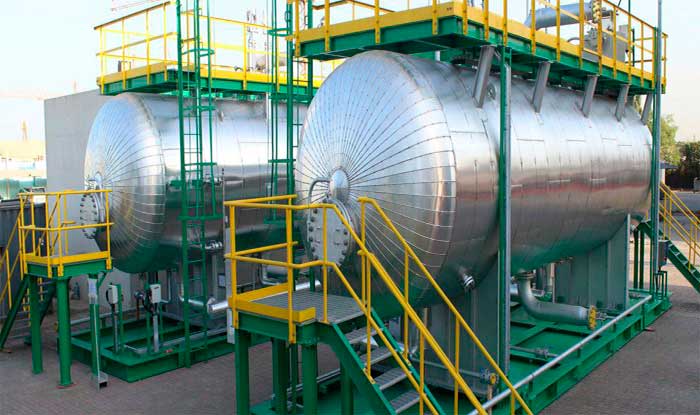
THE DESALINATION AND DEHYDRATION OF HYDROCARBON, PERFORMED UNDER DIFFERENT PROCESSES, ALLOWS THE EXTRACTION OF SALTS, WASTE AND WATERPROOF CONTENTS. When the oil is extracted from its depths, it usually goes through processes that make it suitable for its subsequent use. It often contains gases, unwanted contaminants, soluble solid particles such as sand and salts dissolved in water called brines. This salt leads to certain problems such as corrosion and tartar so it must be extracted from the crude. As the salt is diluted in water, desalination removes not only salt but also residual free water. To remove the salt from the oil, you can remove the water it contains, or dilute it. Desalters are used for this purpose that can perform both tasks and using electrostatic charge remove most of the water or inject clean water to dilute the salt concentration.   Oil goes through several processes for desalination and dehydration. The measurements of the typ...

Surface equipment in oil extraction

Image
The oil landscape par excellence has always been dominated by the image of the pumpjacks, used since the beginning of oil extraction to this day. The iconic universal image regarding oil extraction is the pumpjack : one of the superficial pumping units in oil extraction, apart from the hydraulic unit. This pumping unit converts the angular movement of the shaft of a motor or reciprocal vertical into the ability to drive the string of rods and pump the subsoil to bring the hydrocarbon to the surface. The revolutions per minute of the driving machine are closely linked to the variation of the pumpjack's speed and the variation of the counterweight acts against loads of bars and fluids of the well.